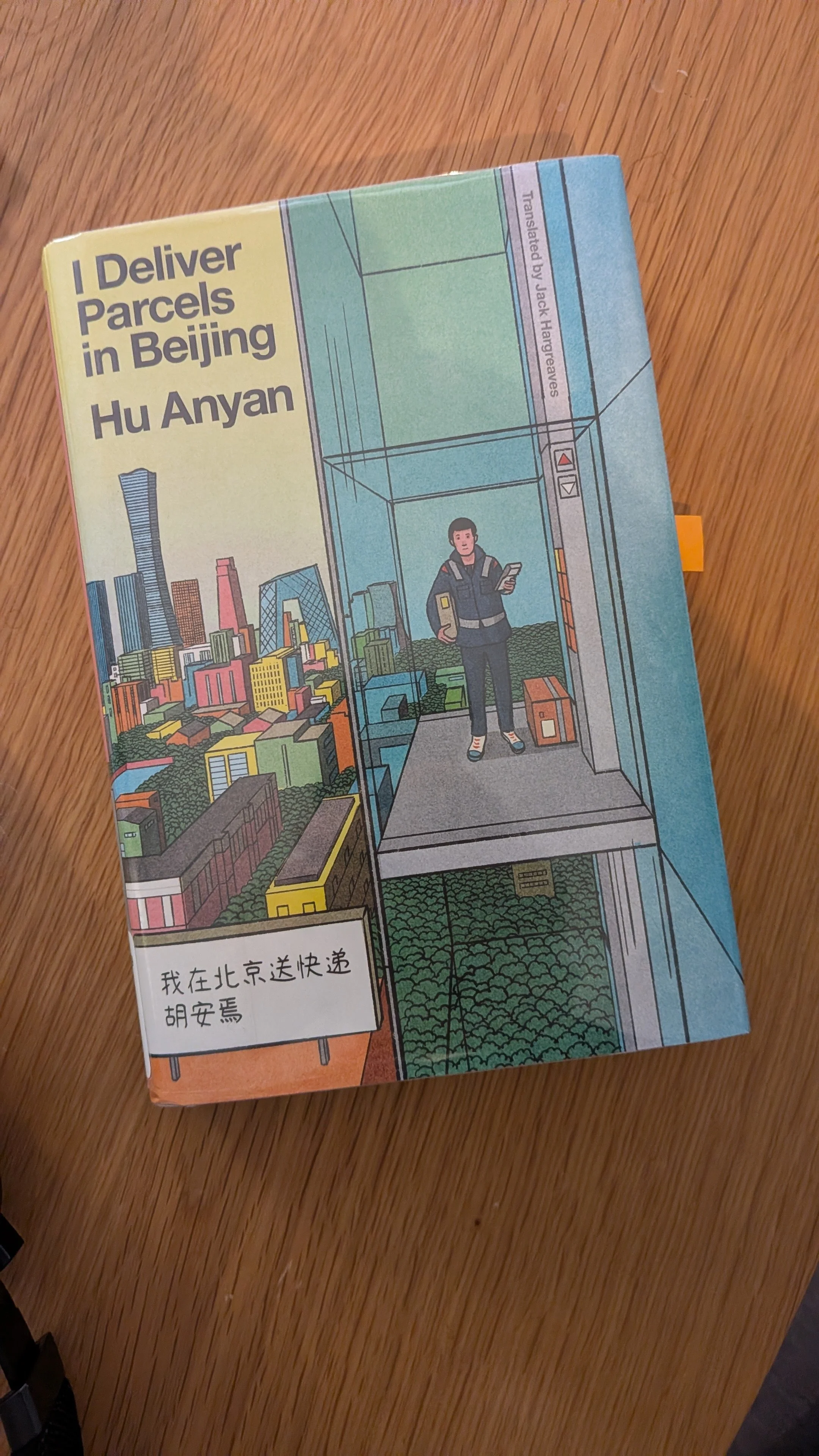
I DELIVER PACKAGES IN BEIJING - HU ANYAN
I got this one because it’s so buzzy and I’m always interested in what Chinese cultural products make it to America. I have two major thoughts on this book. The first has to do with the structure. Both the title and the way to book is laid out makes it seem like Hu is going to tell his autobiographical story about being a delivery driver. The first half of the book is about this, we follow him on his deliveries, we learn what is expected of a chinese delivery driver (which seems to be much more involved than, say, an Amerikan Amazon driver), we see how brutal the work can be, we learn about the pay and how he lives. This part was alright, but, for me, it went on too long. It wasn’t terribly well written so it does really come off as the blog post it started as. It’s interesting to think about the difference between work in Amerika and China, and the ways in which China’s economy is changing, but you have to really dig down under the text itself for this stuff, and the text is just mid. But then the book takes a turn in the second half. Earlier, Hu comes off as a sort of aimless slacker who’s drifting through life and taking this job because it’s what’s available to him and he doesn’t have some greater ambition so who cares what he does. Well, turns out this isn’t the case. The second half of the book follows Hu on his journey through employment in general and catalogs the various jobs he’s held. Plus, he travels around the country, from huge megacities like Shanghai and Beijing, as well as small, underdeveloped towns. It turns out he was ambitious, he attempted to run several clothing stores and to work as a writer. He has a sort of capitalist spirit, and inner entrepreneurism. He talks often about how stifling regular employment can be and how he needs to follow his dreams. He compares himself with his parents and their generation. So the Hu we see delivering packages at the beginning is more the outlier, especially now that he is famous (in China) and a full time writer. I found this section of the book much more interesting and wish it was longer relative to the package section. I also do not think the book benefited from this non-chronological structure. He could have just told the story as a traditional memoir and it would have been more affecting, I considered stopping at the beginning chapters. Because the sections about how the nature of work is changing in China is easily the most fascinating stuff to me. Here’s a passage where he talks about his love for Amerika writers and how he sees their artistic style as related to the mode of production in the country, “I was very fascinated by American realism; the lives and emotions described in these stories were powerfully resonant. This might have been to do with the fact that commodity society and consumerism were talking over the entire world: People’s life experiences were being universally homogenized.” Which is quite interesting but does bring up my second, more insane, thoughts on this book. Is this a psy-op? We get so little, culturally, from China. There is the Three-Body Problem (which is still pretty niche, despite a TV show) and some Kung-Fu movies (but not really any current ones) but that’s basically it. And it’s not like that region of the world is overlooked by American culture writ-large (like, say, central Asia), we’ve got Korean and Japanese culture out the ass, and all of that seems very purposeful. It’s not like we’re flooded with Chinese stuff and people don’t really like it, we just don’t get the stuff translated and brought to us. So when stuff does break through, I’m suspicious as to why this piece of Chinese culture is being highlighted. Hu is showing us a very American version of the Chinese economy, with small businesses (cool, street-wear adjacent fashion and drop shipping, no less), and gig work and alienation and precarity and all that. And while I’m sure his experiences are his experiences and he’s being honest about his life, I do think it plays into this idea that China is just like America and also capitalist in the same way and actually worse in some ways, in terms of workers’ rights. And I think that idea is propaganda and cope. The book “How China Works” does a good job showing how China doesn’t actually look very much like a Western capitalist country when you really understand what is going on. I think this line of reasoning is designed to stop people in the West from looking at what China was able to do and asking why we can’t have that, since it tells them that China is basically the US anyway. It’s a current variant on the There Is No Alternative (TINA) psy-op that they’ve maintained since the USSR fell. Anyway, I did enjoy the second part of the book, I’d love to read more about life in China generally. I hope this book’s success brings us more diversity in this area, China is going to retake its place as most important nation in the world during my lifetime, I’d love to know more about them.