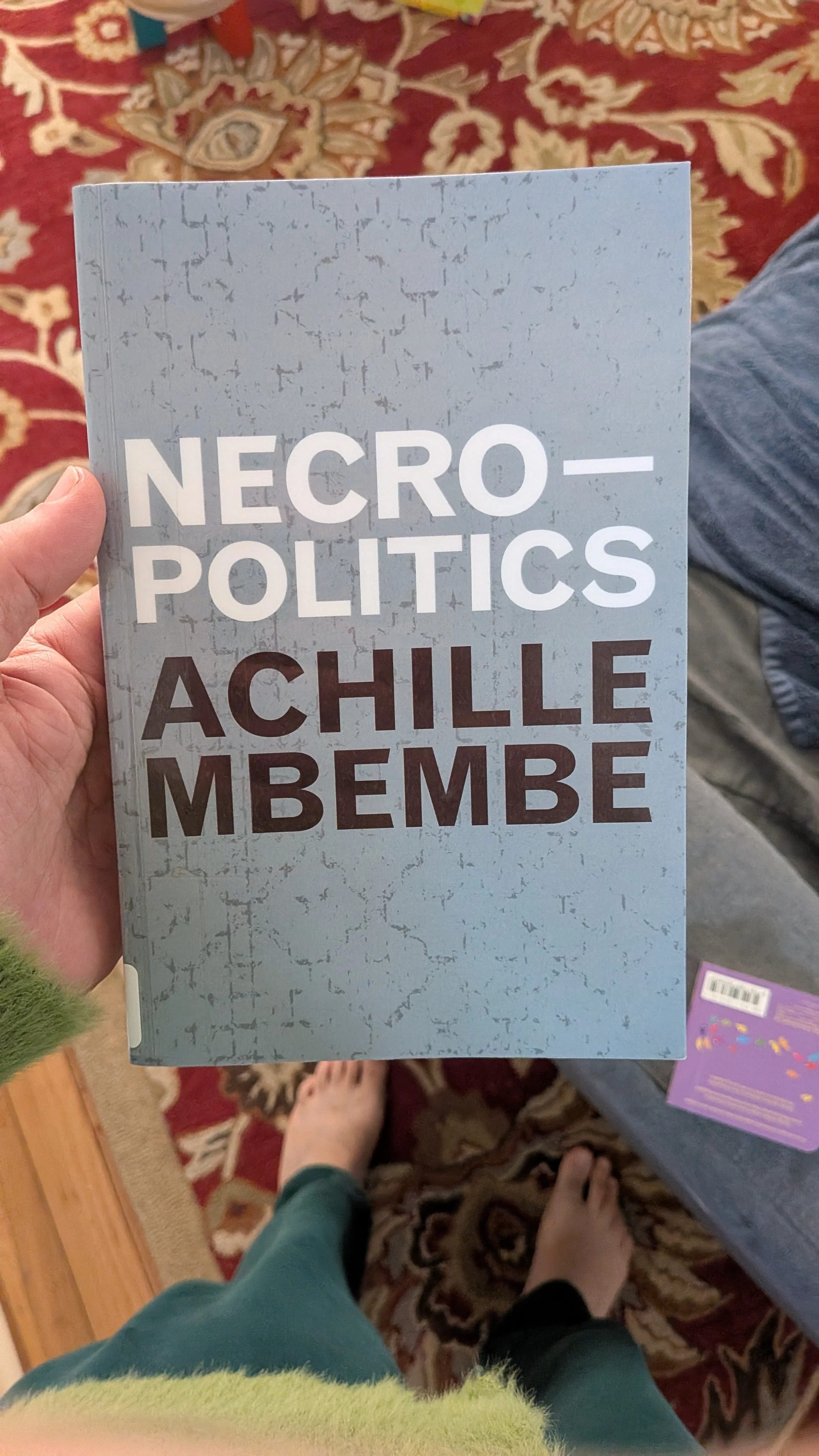
NECROPOLITICS - ACHILLE MBEMBE
I believe I had read this guy’s essay with this name a while ago but never got around to reading the whole thing. Amazingly, the local library carried a copy, despite it being somewhat in the weeds, theory wise. Mbembe’s coinage of “Necropolitics” has become troublingly relevant in the decade or so since he wrote this thing. The term is a sort of fleshing out of Foucault’s concept of biopolitics, or the idea that power/knowledge operates by controlling and managing people’s lives through things like public health and hygiene. Now, between the rise of things like yoga-as-exercise or the pandemic or MAHA or GLP-1, this concept is not without relevance either, but Mbembe brings to light the dark side of these ideas and concepts when he discusses how power also operates by creating death-worlds or “new and unique forms of social existence in which vast populations are subjected to living conditions that confer upon them the status of the living dead.” He lists the colony and the plantation as the sort of precursor to this concept, the test run or version 1.0, while something like Palestine, especially recently, would be a current example. Or the vast homeless encampments that fill up or cities, or the ICE detention centers, or the racialized sections of our cities that have been violent and hopeless for generations now, or the post-industrial fentanyl-chocked rust belt areas, or the nowhere, emptied out also fentanyl-chocked rural wastelands. There really are no shortage of death-worlds in Amerika these days. Plus, it’s now how we wage wars. We don’t have a strategic aim in the traditional sense of taking something over and running it, instead we bomb it and use targeted death squads in the form of our Tier 1 operators as well as less elite proxy armies to sow such chaos and violence that a society collapses into total death-world which makes it easier to achieve some geopolitical goal. We did this in Iraq and Libya and Somalia and Syria, and were currently trying to pull this off in Venezuela and Cuba and Iran. Like most theory, I read this thing as a sort of assemblage of tools and concepts some of which are more relevant or interesting to me than others. There’s a lot about Fanon in this book and a sort of rehash of his ideas. I found this part less interesting, since I feel like I could just reread Fanon if I wanted these concepts, tho he does a good job of summarizing his ideas about how “Blackness” works as a psychological concept. Tho, the idea of the death-world is really the main takeaway here for me. Now, it is not all hopeless for Mbembe, he does, in my opinion, write beautifully about how we might get out of this mess. “Owing to this structural proximity, there is no longer any “outside” that might be opposed to an “inside”, no ‘elsewhere” that might be opposed to a “here,” or “closeness” that might be opposed to a “remoteness.” Once cannot “sanntuarize” one’s own home by fomenting chaos and death far away in the homes of others. Sooner or later, one will reap at home what one has sown abroad. Sanctuarization can only ever be mutual…a democracy-to-come will rely on a clear-cut diction between the “universal” and the “in-common.” The universal implies inclusion in some already constituted thing or entity, where the in-common presupposes a relation of co-belonging and sharing-the idea of a world that is the only one we have and to be sustainable must be shared by all those with rights to it.”