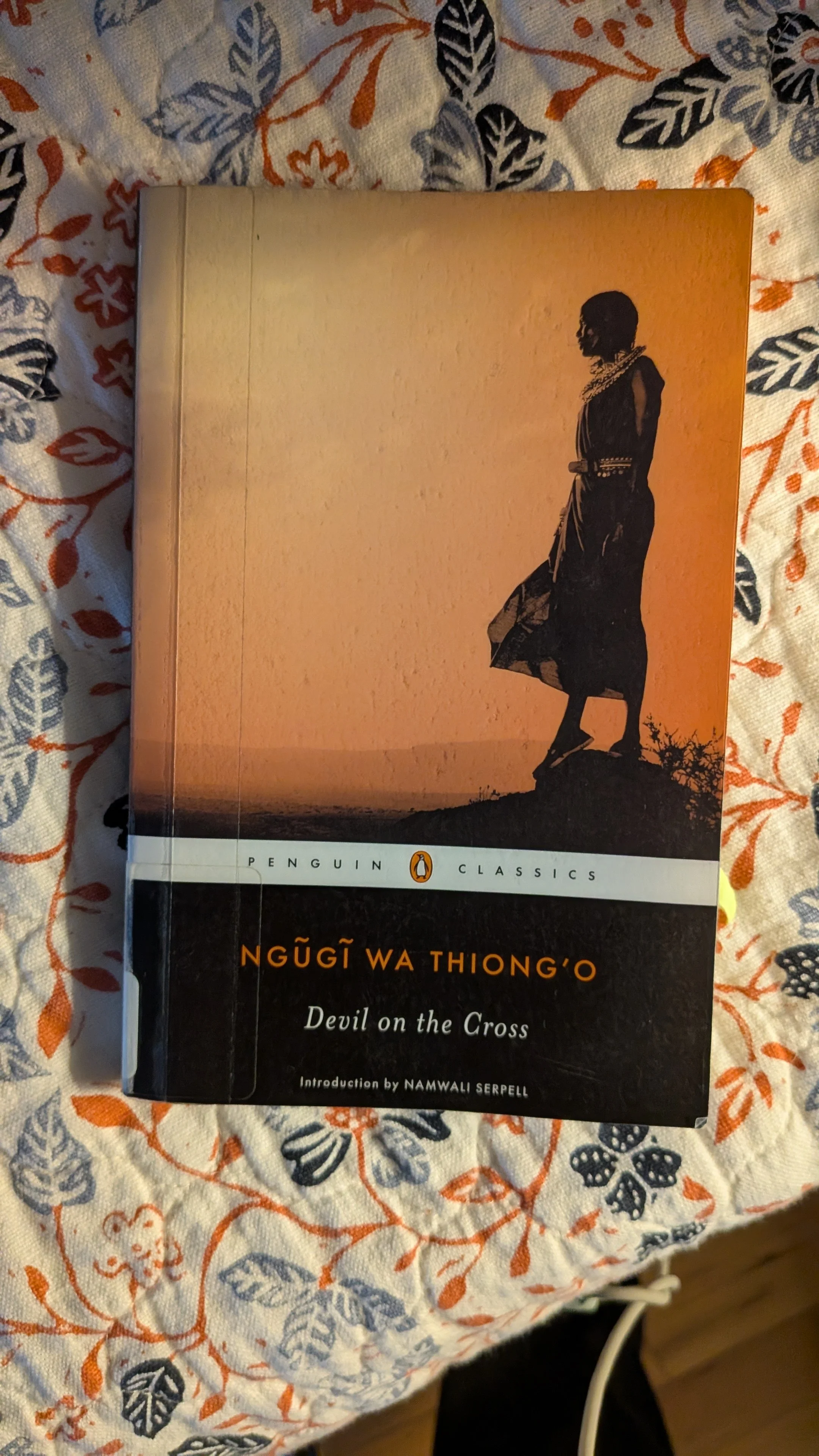
DEVIL ON THE CROSS - NGŨGĨ WA THIONG’O
I’ve had a lot on my plate recently, so my reading has suffered a bit. As such, I’ve been trying to focus on some shorter books that are a bit easier to knock out. I had long heard this was a classic of modern African literature, and when I saw that the library had it and that it was only about 300 pages long, I jumped. I believe this is the only book by a Kenyan writer I’ve ever read. Thiong’o famously wrote this on toilet paper in prison and in Kikuyu, despite being more than able to write in English. This is sort of the African equivalent of Dante choosing not to write in Latin. This is an obviously political choice, as well as an artistic one, that resonates in a very political book. Usually, the African literature I’ve read either deals with a pre-colonial time period, the colonial time period and/or the struggle against colonialism but rarely the neocolonial period after official colonialism ends. And this book tackles exactly that period. Actually, the book really reminded me of the Iceberg Slim book, Trick Baby. As in that book the main character here gets a sort of behind the scenes look at the evil plan at the heart of the world. In this novel a young Kenyan woman, Jacinta Wariinga, tries to live her life in post-colonial Kenya, where she is taken advantage of and exploited and fucked with until she reaches the point that she wants to kill herself. At her lowest point, she’s saved and invited to an event called The Devil’s Feast, which she decides to attend. The event, run by the Organization for Modern Theft and Robbery, is a sort of forum for the newly liberated Kenyan bourgeois to discuss their schemes and plots by which the rob the people of Kenya, and their desire to join the ranks of the international bourgeois, many of whom are in the audience (from the US, UK, Japan, etc.) and are going to judge who the greatest thief in the country is. If all goes well, the Kenyans hope to get their chapter of thieves and robbers accepted into the trans-national vampire class. That part of the book is a bit didactic. There are chapter long speeches where different businessmen talk about how they cheat and rob people, how they swindle working people out of their money and live off of the toil of others. Now, I’m someone who believes we can’t hear this message enough, and I’m someone who has been to and lived in post-colonial nations across Africa and the rest of the so-called third world and this is a very, very real dynamic. There is a stark class divide and a handful of shockingly evil vampire clans that control all the wealth in a country while everyone else lives in the most dire poverty you can imagine. And I’ve never read a work of fiction that makes this dynamic clearer. Now, I don’t want to make it seem like this book is only a political economy lesson, though it is primarily that, the story that wraps around these speeches is also quite good and concludes quite nicely. There are some really striking images, like the titular devil on the cross, as well as some really succinct and cutting descriptions of how the world operates. In the almost 50 years since this book came out, the Devil’s Feast has only become more clear. As the transnational cartel of thieves and robbers continue to do their work, with deeper and deeper perfidy and greater and greater skill, it’s more important than ever to be clear-eyed about what is really going on. I’m going to use the Devil’s Feast as a useful metaphor for some time.