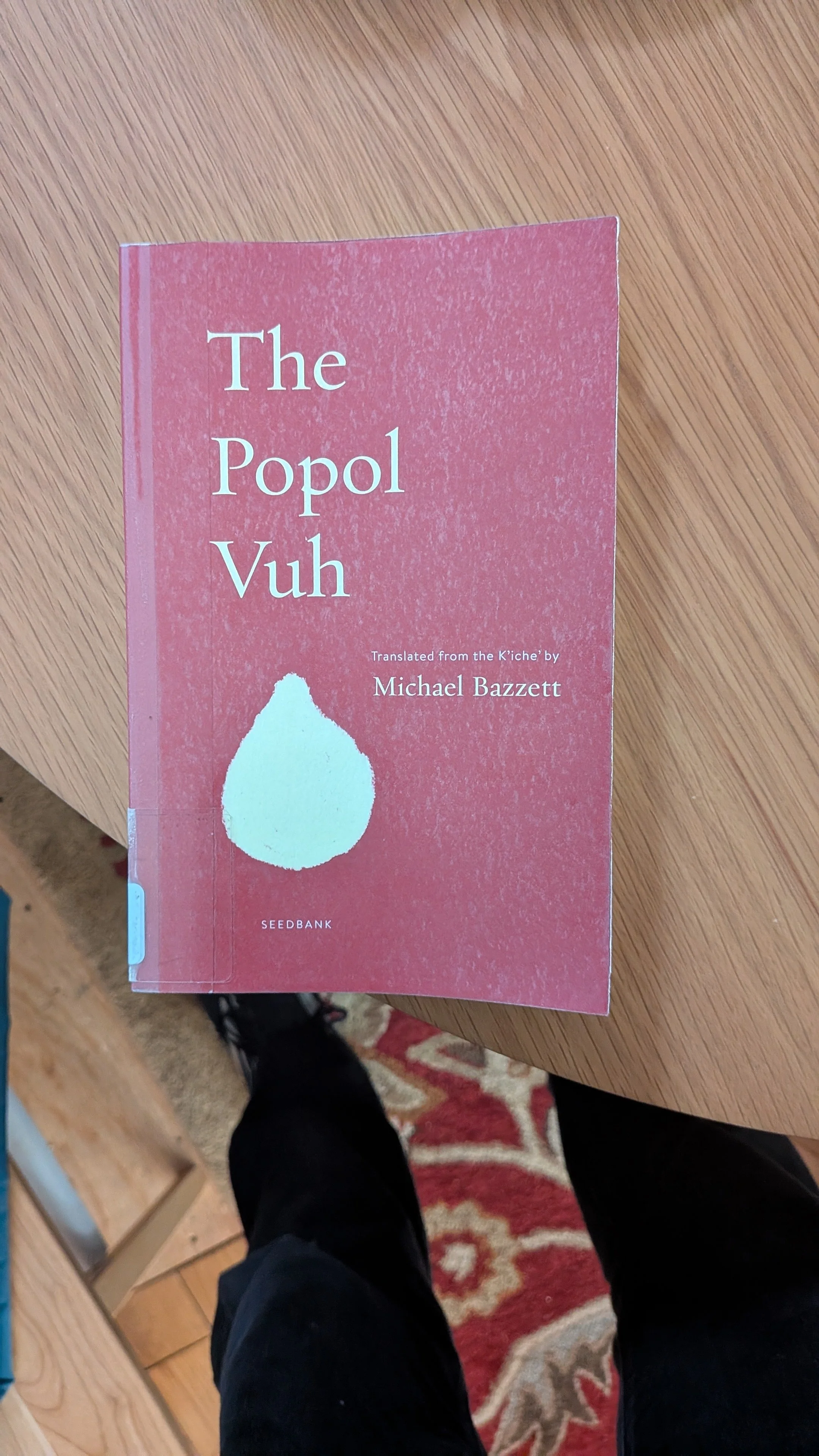
POPOL VUH - trans. MICHAEL BAZZETT
You might not know this but reading the same children’s book every night, even if it’s something good like The Lorax, is tedious. But I recently discovered that if I start with children’s books, I can switch to something else while I’m trying to put my daughter to sleep and since she’s just focused on my beautiful basso profondo voice. So I ended up reading the entire Popol Vuh “to” her over a week or so. When she was really little I read a large portion of the Iliad and Odyssey to her, so she’s not unfamiliar with epic poetry, read in translation aloud. Reading aloud is not something I do very much of at all, but it is a really good way to come at a text that did exist for many hundreds of years as an oral tradition before being written down. Especially since in both cases here (the Homer stuff and the Popol Vuh) the translators really put a lot of work into making the text poetic and focusing on the flow and rhythm. This is a beautiful work, I read it way back in college so I’d forgotten most of the plot points, such as they are. I remember the hero twins, Hunahpu and Xbalanque, how they take on the Lords of Death in Xibalba and eventually defeat them. I had forgotten that the poem goes both before and after this event, and shows us the creation of the world, early attempts by the gods to make people out of mud or wood, eventually making humans out of corn, the fathers of the twins and their adventures, and the first dawn. It was nice to be able to teach my child about the dangers of self-aggrandizers, since all of the villains in this poem have that as their major flaw. It often feels like we are still ruled by the lords of death and it’s nice to read a story in which they are overthrown and no longer demand our blood sacrifice. I know there are interesting readings of this poem that track the lords of death to the Mayan upper class during their classical period and see the poem as a sort of mythical version of these social structures overthrown. I’m quite intrigued by that but don’t know enough about Mayan history to really have an opinion. Likewise, there are questions about how much Christianity was subtly introduced by the monks that recorded this (we don’t have the original Mayan they worked off of), since there are things like virgin birth which could suggest such a cross-contamination. Or, it could suggest a sort of perennial philosophy type situation, either way, it would have been nice to get some speculation from an expert. Sadly, the intro to this volume is short. I suppose I would rather have Bazzett focus on the translation itself if I had to choose, but I feel spoiled by those Emily Wilson intros to her Homer translations which offer thoughts on translations, both generally and specifically, and history and interpretation and explanation. This book has a short intro and a readers guide in the back, which does pull out some themes and structures but mostly just recaps what’s in the poem itself, which is weird because the poem isn’t too difficult to understand on a plot level. I will have to look elsewhere for broader musings. I think I might read the kid the bible next.