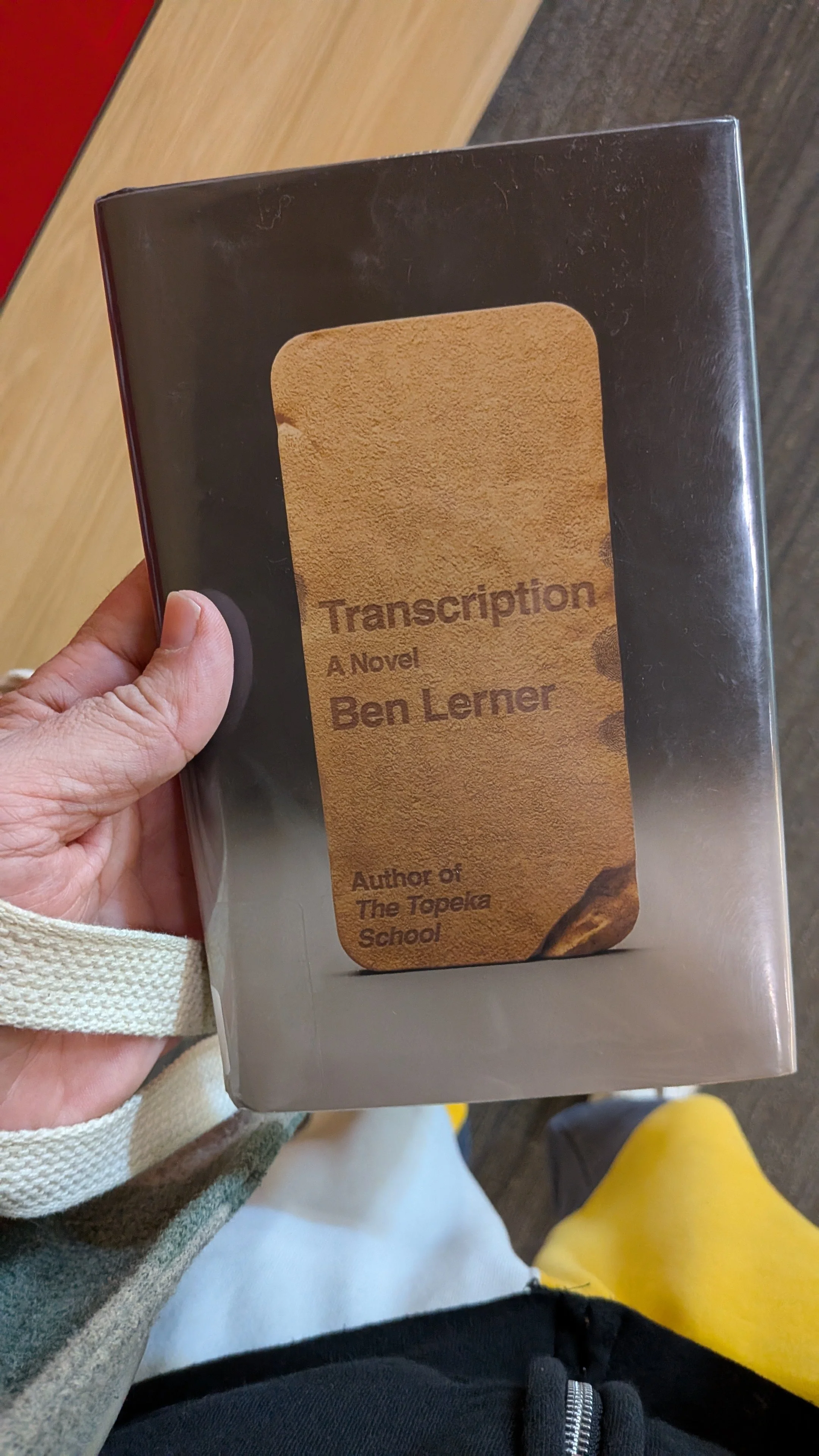
TRANSCRIPTION - BEN LERNER
I had been mostly avoiding Lerner because his public persona seemed annoying. I’m not interested, generally, in the lives of writers or poets or fiction about the lives of writers or poets (and I say this as someone who loves Bolano and has read 100% of his work available in English), since, almost by definition, they have boring lives which they spend behind desks, thinking alone. But, I have been stuck in rut w/r/t reading given how busy and chaotic my life is right now so I needed a quick little bite of a book so I picked this one up to speed through it real quick. I guess I thought he did something closer to autofiction. This ain’t that. The main character is a writer and an author but I don’t think it is supposed to be Lerner in any deeper sense. The book is divided into 3 sections. In the first section the narrator, who remains unnamed, goes to interview his mentor, an elderly, respected author named Thomas. He, the narrator, drops his phone before the interview so he’s not able to actually record what is said. The next section takes place after Thomas has died at a conference dedicated to his work, where the narrator reveals that he published the interview with Thomas without having a recording, ie he just wrote down what he remembered, which makes people at the conference upset. Finally, in the last section, he talks with Thomas’ son about his life. What I liked most about this book was the directness with which the work deals with both phones and what they’ve done to us socially and culturally as well as COVID and what it did socially and culturally. This isn’t sci-fi, there isn’t a cleaver metaphor for the phone nor does it take place in an alternate timeline or the near-future where the phone thing is different to draw attention to what’s going on here and now. This book is all here and now, the characters live in our world and have the relationship to phones that we have. We get the dread of being on a trip and breaking your phone, we get the ways in which the phone connects us but drives us apart. We get parents talking about how they manage screens with their kids. There is actually a lot about fathers and fatherhood (both in the literal sense, as well as the mentor-as-father sense) which also appealed to me. The book also includes both references to COVID and the lockdowns as well as an extended section about a family member (nearly) dying during the height of the pandemic. The further we move away from the really gnarly early 2020 days of COVID the more and more shocking it is how little art there is that discusses this (there is a parallel here to how little art there is about the Spanish Flu) which I take as a bad sign, culturally. Lerner is a poet so the writing here, on a sentence and word choice level, is beautiful. There is a particularly lovely passage where he talks about seeing glass fruit as a child and how he could switch in his mind from seeing them as artificial to seeing them as “real” fruit and back again, and how he can make that same move with something totally natural like the sky and how that toggling feeling is the basis of his fiction. I liked how slight and easy this book was. There is certainly huge volumes to be written about what phones have done to our brains, I admire that he tackled this without trying to give us a definitive statement. He seems confident he’s going to build a small library of work over his career so no one piece (at least for now) needs to be the masterpiece. I think I’ll check out his stuff as it comes out from now on.