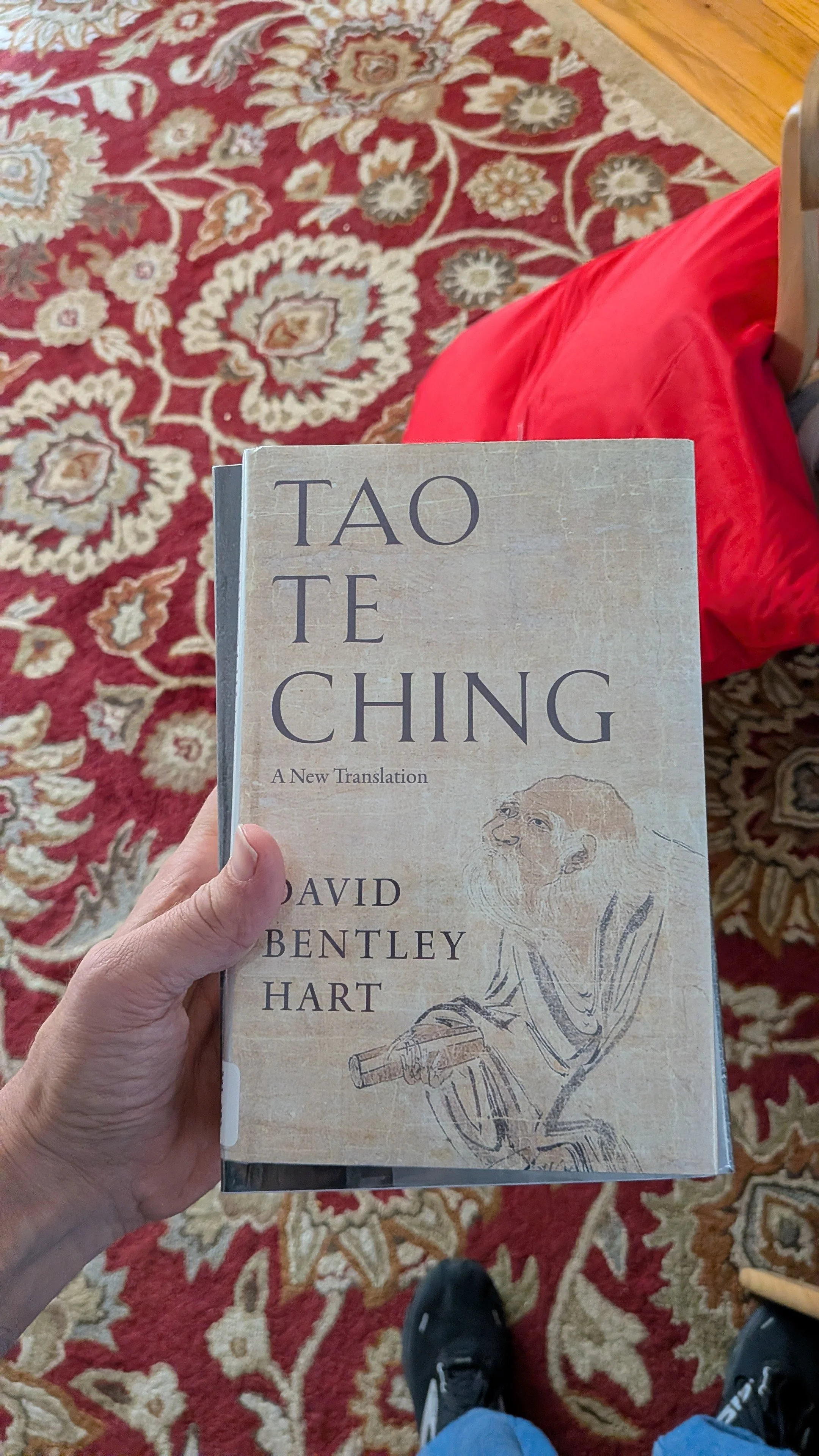
TAO TE CHING - LAOZI (trans. DAVID BENTLEY HART)
This is another nighttime read. I read it to my daughter as she was falling asleep, slipping it in after she’s really paying attention to the Curious George and whatnot. Letting it wash over her. Which seems fine, who cares that she’s not really listening. She, as a toddler, is much closer to living in a Taoist manner than I am, she’s much more tuned into the Way. I don’t think I’ve read this thing since High School or early college. Obviously a drop-dead classic and basically the only piece of Chinese culture (outside of, maybe, kung-fu movies) that most Amerikans are familiar with. At some point I got familiar with the Zhuangzi, which I considered and consider the superior Taoist text. I find it more playful and less cryptic than this work. I had forgotten how much of this book is written to a ruler, something like The Prince, and thus is quasi-specific advice about how to rule a nation. In typical Taoist fashion, it turns out that such a leader should not act, or act only in accordance with the Way. I suppose I would like our leaders to follow this advice, though it does seem confusing. It really is a mysterious little book, it keeps insisting to you that you don’t understand it and that the very topic of the book is impossible to write about. Part of what made me want to pick this up is that the translation is by DBH, who is a famous orthodox theologian most famous for not believing in hell and whose translation of the New Testament I’ve read half of. His translation is quite clear and interesting. First of all, it’s amazing that he can translate both classical Chinese and the Greek of the New Testament. What brains. Secondly, he writes convincingly how, starting with Ezra Pound, modern Chinese translation comes through an understanding of Japanese poetry, which is starker and less florid, so we end up getting Chinese translations that try to replicate a stylistic sense that is not native to the Chinese. He doesn’t try to match word to word or line to line, he gives himself space to use as much English as needed to get the point across. He also talks about how “feminine,” in the sense of mystery and non-action, the Tao Te Ching is relative to other sacred or mystical texts. He sums up the whole thing thusly, “This is the shining revelation of the book as a whole-this recognition that life is one, that there is a one spiritual reality flowing through all things, emerging from and returning to a mysterious and eternal source, divine or cosmic or what have you, where we all-human and otherwise-belong to one another intrinsically.” Beautifully put. It’s hard to know what a true Taoist life would look like. Not acting, acting only in accordance with the Way, where do we start? But this is the most appealing part of Taoism, it really is a system that will not let you resolve the inner mysteries. The texts and commentaries and theologies built up around it are not meant to elucidate or explain, they’re meant to unsettle and beguile. I could certainly think of worse paradigms to bring up my children in.