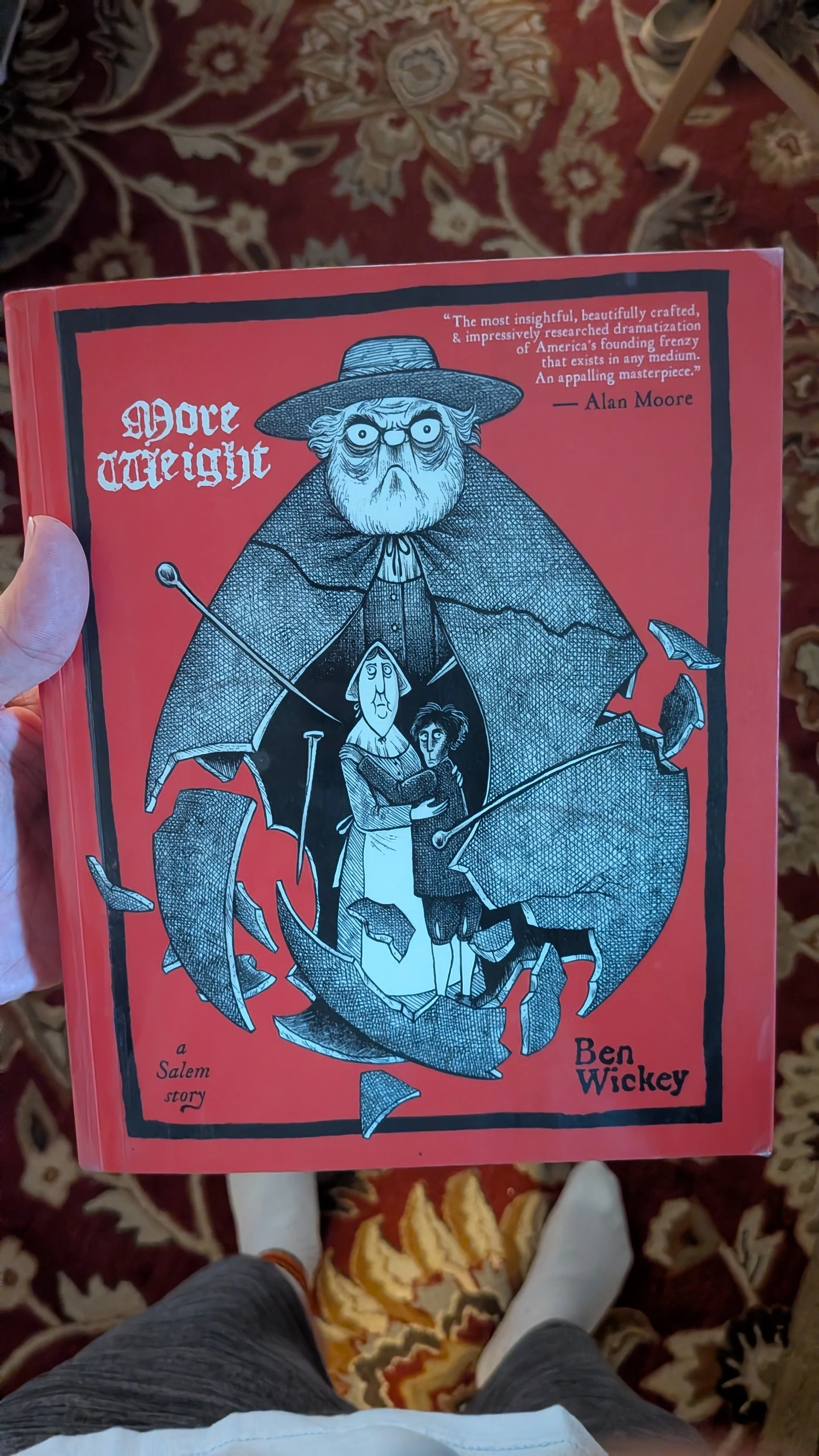
MORE WEIGHT: A SALEM STORY - BEN WICKEY
It’s been a minute since I’d read a graphic novel and seeing one with Moore’s blurb on the cover as well as clearly being a big, beautiful tome, made me pick up this one on a whim at the library. Full disclosure, I’ve never been a big Salem witch trails guy. I feel like they try to psy-op us into thinking the American story starts with Plymouth rock and the puritans and that the great sin of our nation in the Witch Trails, when, in reality, the start is Jamestown and the sin is slavery and Native genocide. Like the Japanese Interment, it does seem like there is a conscious effort to highlight a more minor transgression as the major mistake. But I’m not fully uninterested in the story, and this seemed like a good place to learn more about it. This book is quite thorough and is trying to do something interesting. It weaves the story of the Giles Corey, the man who died the most gruesome death when he was pressed to death for not entering a plea, alongside a parallel story where Longfellow and Hawthorn (whose ancestor was a Witch trail judge) wonder the streets of 19th century Salem and reflect on what the trials mean at that point in history. It’s in interesting choice to not just tell the story, from the start of the colony to the first accusations to the hangings, this way makes it a little more engaging since you’re following Corey and you have to sort of fill in the other parts (like, why’d the girls make these accusations). Finally, there is a masterful final section that reads as more straight non-fiction where Wickey updates us on everything that happened since right after the hangings (the Corey section focuses on him but follows the tale from the beginning of the trials to the mass hangings), which includes the what we know about how those involved felt about the events of 1692, many regretted it as early as December of that year, then the bios of everyone major involved, then and most interestingly, the ways the crimes have been understood since that time. So this goes from shame and guilt, Corey’s ghost is apparently seen before major Salem disasters, like an early 20th century fire, to a branding opportunity. Today the local HIgh School is the Witches and the major Halloween festivities and general witch tourism are the town’s economy. And this is really interesting and twisted. First, it seems a bit insane to have the basis of your economy based on something wicked you did, it’s hard to not have it elide from “this was an awful atrocity" to something closer to, “boy, was that wacky.” Again, I’m from the South, and this dynamic is turbocharged if you go see a Plantation. Additionally, there is more weirdness w/r/t 20th century take that there really were witches in Salem, who were part of a surviving, ancient and secret Witch cult based in Europe, and that these people (and all victims of Euro witch hunts) were martyrs and that current Wiccans are in this legacy. This is nonsense but it is interesting that it’s so popular of an idea and Wickey does a good job looking into it. Like I said, this was my favorite part, and I wish it was woven into the whole book instead of this part at the end, almost like an afterward. In terms of illustration, the whole thing is great but the Corey section stands out to me, especially the way he often has the dialogue get cut off by the end of the text and the way he gets the whiteness of the eyes to pop. Overall, at it’s best, it’s really FROM HELL coded, one of the highest compliments I can give.