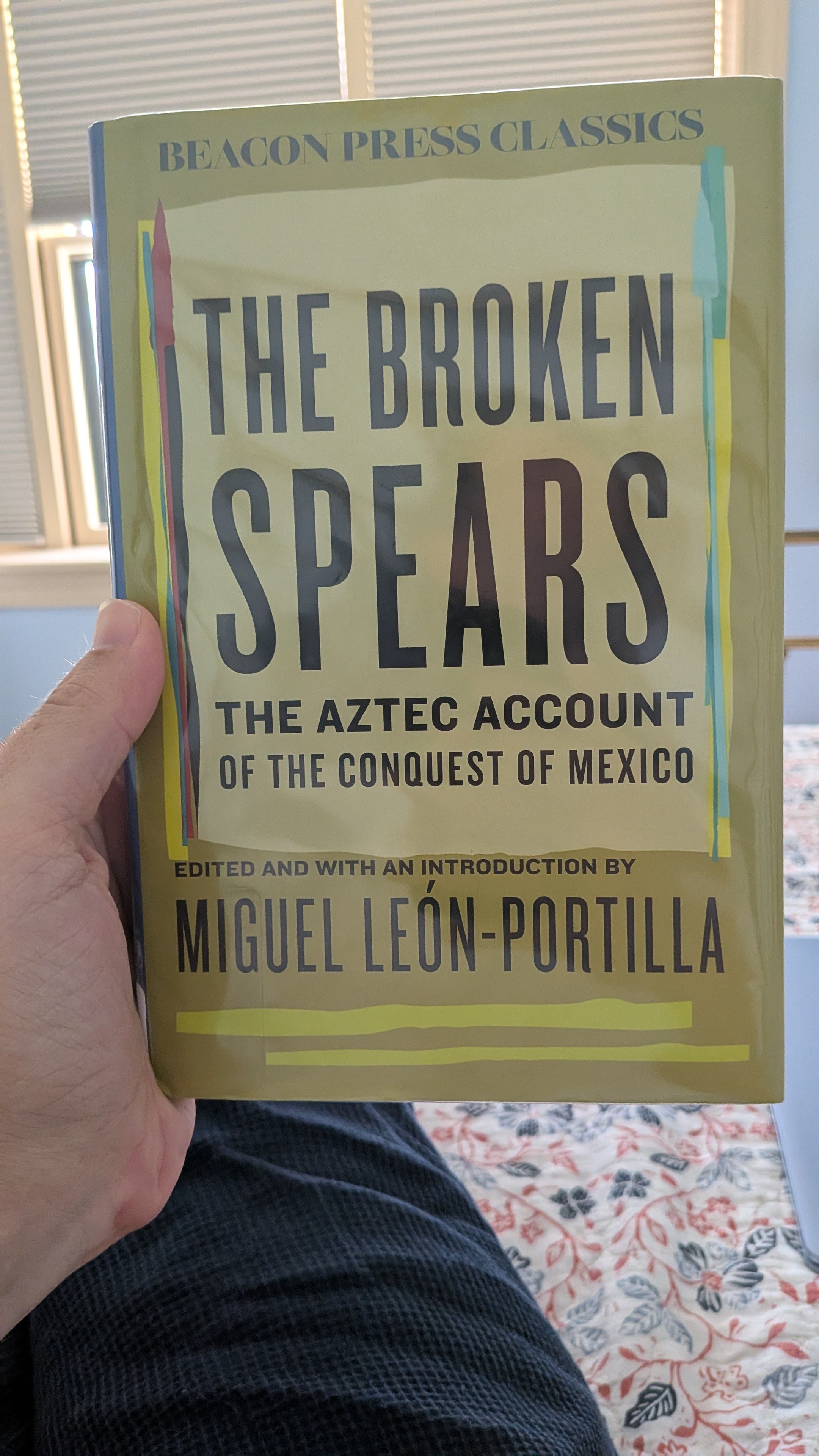
THE BROKEN SPEARS - edited and introduced by MIGUEL LEON-PORTILLA
It really is amazing, like world historically amazing, how big of a fucking psycho Cortes was and how insane and consequential his actions were. I would put Columbus and Temüjin ahead of him, but he’s got to be in the top echelon for sure. Just imagine growing up in 15th century Spain, crossing the Atlantic, coming into contact with the various civilizations in the valley of Mexico and deciding that he was going to team up with some of them to destroy the most powerful. Imagine the troops with him who also grew up in pre-modern Spain and died with their hearts ripped out as an offering to a God they’d never heard of, in a place no one in Europe knew existed when they were born. But now imagine the reverse. The Mexica people were riding high, the Aztec (pedantic but not their name) civilization wasn’t old as the premier power in the valley. They really started their imperial run in the 1480’s so when the Spanish showed up in the late 1510’s their golden age wasn’t even a generation old. And it was destroyed in a way that was so thorough and complete that we’d have to look to the 1258 sack of Baghdad to find an equivalent. Actually in many ways, the epistemicide that accompanied this event was the greatest of all time, or at least it kicked off the greatest epistemicide of all time. If you read this site fairly often you know that I’m pretty interested in this period of history and this book helped fill in another piece of the puzzle. Portilla brings together a bunch of different sources, all of which are native, to tell the story from before the arrival of the Spanish up to the long shadow the destruction of Mexico cast. Zapata’s speech in Nauhua makes the cut towards the end. It’s fascinating how the retelling of this period is drenched in foreboding and dread. All of these accounts come from, at earliest, a generation or so after the arrival of the Spanish, the native authors are basically the grandchildren of the adults who would have experienced the events being described. So, in their telling, the Natives were doomed from the beginning. They record all sorts of omens and visions that went down before the Spanish show up, they often mention how hopeless and worried they were, how they felt that everything was doomed. Now, this might be backward projections, but it also could show a fundamentally different worldview. It made me think of Achilles in the Illiad. It’s amazing how bloodthirsty and insane the Spanish were, how quickly they’d just kill everyone around in order to get gold. Their gold lust is so confusing to the Natives. Also, it was interesting to note how the Native way of waging war, i.e. putting a premium on getting live captives for sacrifice, conflicted with the Spanish mode, i.e. kill everyone as quickly as possible, and how the Spanish (and really European) mode was so much more successful. The only thing that I wish existed would be a Tlaxcalan account that discussed what they were thinking about when they decided to ally with the Spanish. They’re the most interesting group in the valley, given their republican political organization, and we know so much less about them (or at least I know much less about them). Overall though, this book is quite interesting and important and I’d recommend it to anyone who cares about this topic and time period.