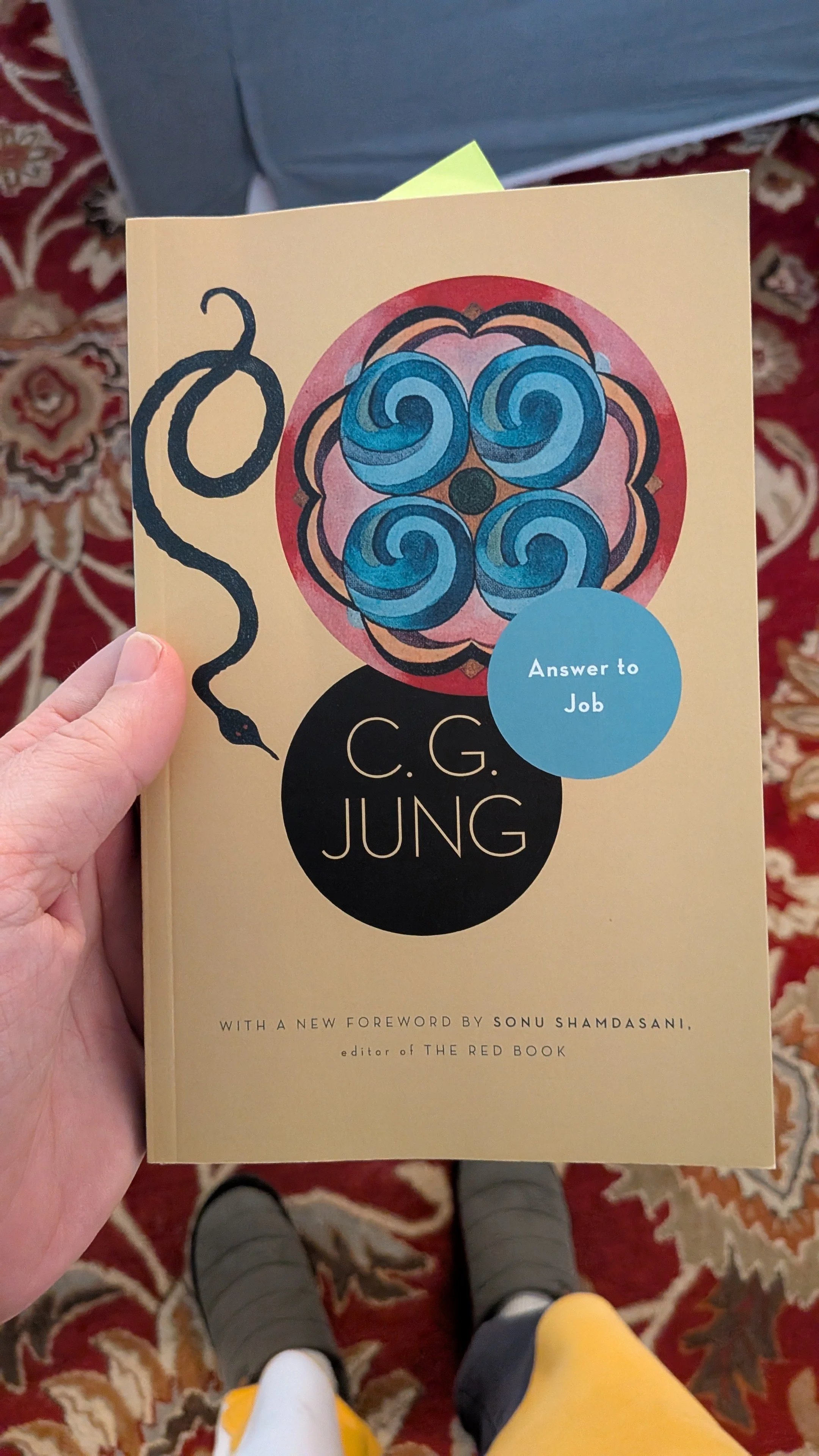
ANSWER TO JOB - C. G. JUNG
One forgets how fucking weird Jung is. Freud and Jung are, for obvious reasons, often thought of together, with Jung being the 'funkier’ of the two and Freud being more “scientific,” but both of them sort of co-creating modern science of psychology. While this is certainly an oversimplification and psychology most certainly isn't a science, it also elides how strange and out there Jung can be. He’s much closer to a religious thinker and writer, he’s vibes-based, he’s relaying his dreams and intuitions, he’s doing something closer to what a shaman does than a scientist or academic does. Even in this book, which is religious commentary, he’s not writing in an academic way. He’s not citing sources or telling you what the archaeology or history says about the circumstances under which this book of the Bible was written or the intellectual history of biblical ideas, he’s doing a sort of Terrance McKenna-style free associative rant. And it’s very unique, I’ve never heard this take on Job before. To back up, Job is certainly one of if not the most baffling book in the bible. I’ve always found it strange that the book ends with God explaining to Job why he allowed all these horrible things to happen to him by citing is own immense power and knowledge and basically saying, “I’m god, you don’t need to question what I’m doing, just trust that I have a reason” which is crazy since we, the reader, know the actual reason for Job’s issues, namely that god made a bet with the devil. And this bit of dramatic irony has endless layers of bafflement. Why are god and the devil talking? Do they regularly do this? Why is god trying to “prove” something to the devil? Especially since he’s omnipotent and knows everything. Why doesn’t God just tell Job the real reason? What does the devil think of this afterwards? Jung takes this story and really blows it up wide. His take is that God is shamed by Job since Job ends up being the most moral character in the story and more moral than God himself. This prompts God to become man in the form of Jesus to sort of “make up” for this transgression against Job. And since it’s Jung and he’s so interested in archetypes and enantiodromia and dualism, he posits that since there is an all-good version of God in Jesus, this explains why there will be an all-evil version of God, perhaps in the anti-christ. And he really folds in a lot. There’s stuff about Sophia and the gnostic versions of christianity. There’s lots of talk of Jesus and revelations and the woman clothed with the sun. He has an interesting take that protestism lacks a female divinity figure like Mary and is thus incomplete. He’s all over the place. It’s quite a great little rant. 100 pages, really heady and strange. I would highly recommend if you want to hear some far out shit about the bible.