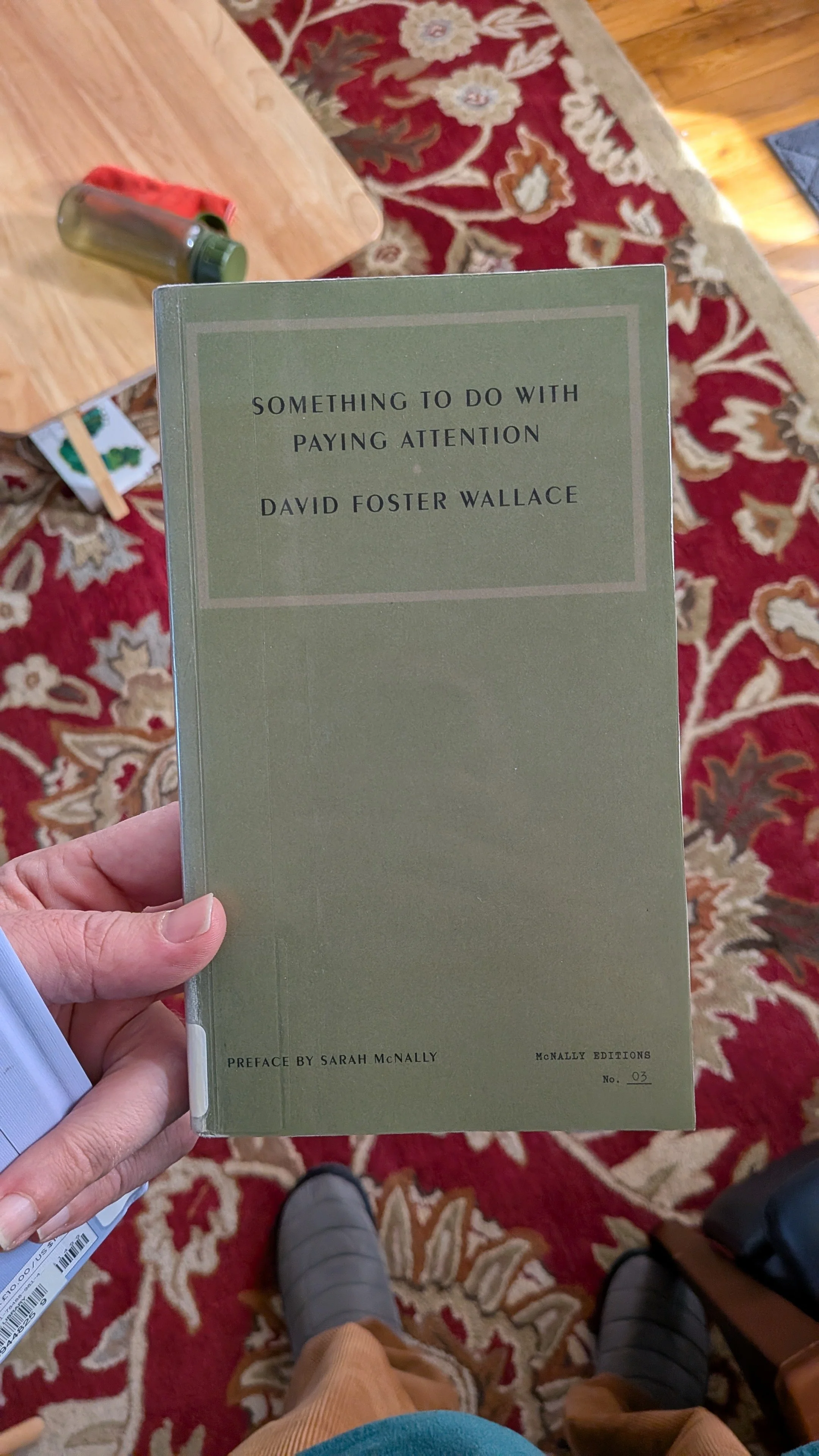
SOMETHING TO DO WITH PAYING ATTENTION - DAVID FOSTER WALLACE
Now, does this count? I keep track of the books I read, as you obviously know since you’re reading this. I do review almost all of them (it is pretty rare I read something all the way through and don’t review it, though it has happened), including rereads, and I keep a count. So, I ask, could this count towards a total? This book is a section, about a 125 page section, of DFW’s Pale King, the book he was writing when he killed himself. I read the Pale King when it came out on tax day 2011. DFW was pretty ascendent in the culture at that point (he’s fallen off hard since his suicide, I would say, you don’t hear alot about Infinite Jest anymore) and I believe I had then read all his stuff. I remember thinking the book, Pale King, was quite good in parts, but overall, unfinished. It was no 2666, the other massive posthumous book from that era that is very much finished and perfect. In a strange twist, I had been thinking about it when I heard that they’d published part of it as a standalone volume and then found out the local library carried it and that it was short enough to read in a day. This is some of the best stuff in the Pale King, at least as I remember it. Interestingly, I remember a few details from this section I read over a decade ago, but I don’t remember them being part of the same monologue. It’s actually a sort of nested monologue. The whole thing is a character’s speech to new IRS agents (Pale King is about an IRS office in Peoria) which itself contains a speech he was given when he joined the IRS himself. Say what you will about DFW, and I’ll get to all that in a second, the man is really a top notch writer. Very technically skilled, he can meander and spin out a yarn to incredible lengths but still maintain the sense that every word is perfectly selected and you never lose track of what’s going on, even when things go big. Unfortunately, it suffers the flaws of the other DFW works: it’s often corny and treacly. The good part of Infinite Jest (the tennis academy stuff, the junky stuff is maudlin to a degree that almost sinks the book) focuses on aimless young people, who feel like they have potential but can’t seem to live up to it. They’re wastoids, to use DFW’s term. And no one is better than him at rendering how this particular lostness feels. Interestingly, this feeling along with the paralyzing self-consciousness that accompanies it has only become more pervasive in general and especially among young people since he died; he would lose his mind if he could see social media. The problem is that he gets so preachy and corny when he tries to offer a solution. Work hard, be boring, pay attention to your life. This is all fine advice, and he offers a better version of it in his “This is Water” speech, but to me, it rings hollow. The problem is bigger than one’s individual life and perspective. For instance, he doesn’t really go into the issues one might have with the IRS or what those taxes are being used for or why some people don’t pay them at all while others sit in jail for avoiding them. The problem for him is always individual. He says in this that all the facts of the world are settled, the question now is how you react to and deal with these facts. This worldview will always make the solution individual, which isn’t really a solution at all. You read this stuff and it’s clear why he killed himself, the exit he thinks he’s found is another dead-end. Anyway, great writer, I like the idea of taking sections out of longer books and publishing them by themselves. I’ve only ever seen this before with the Grand Inquisitor section from Brothers Karamazov. It’s funny to imagine them doing this with 2666.