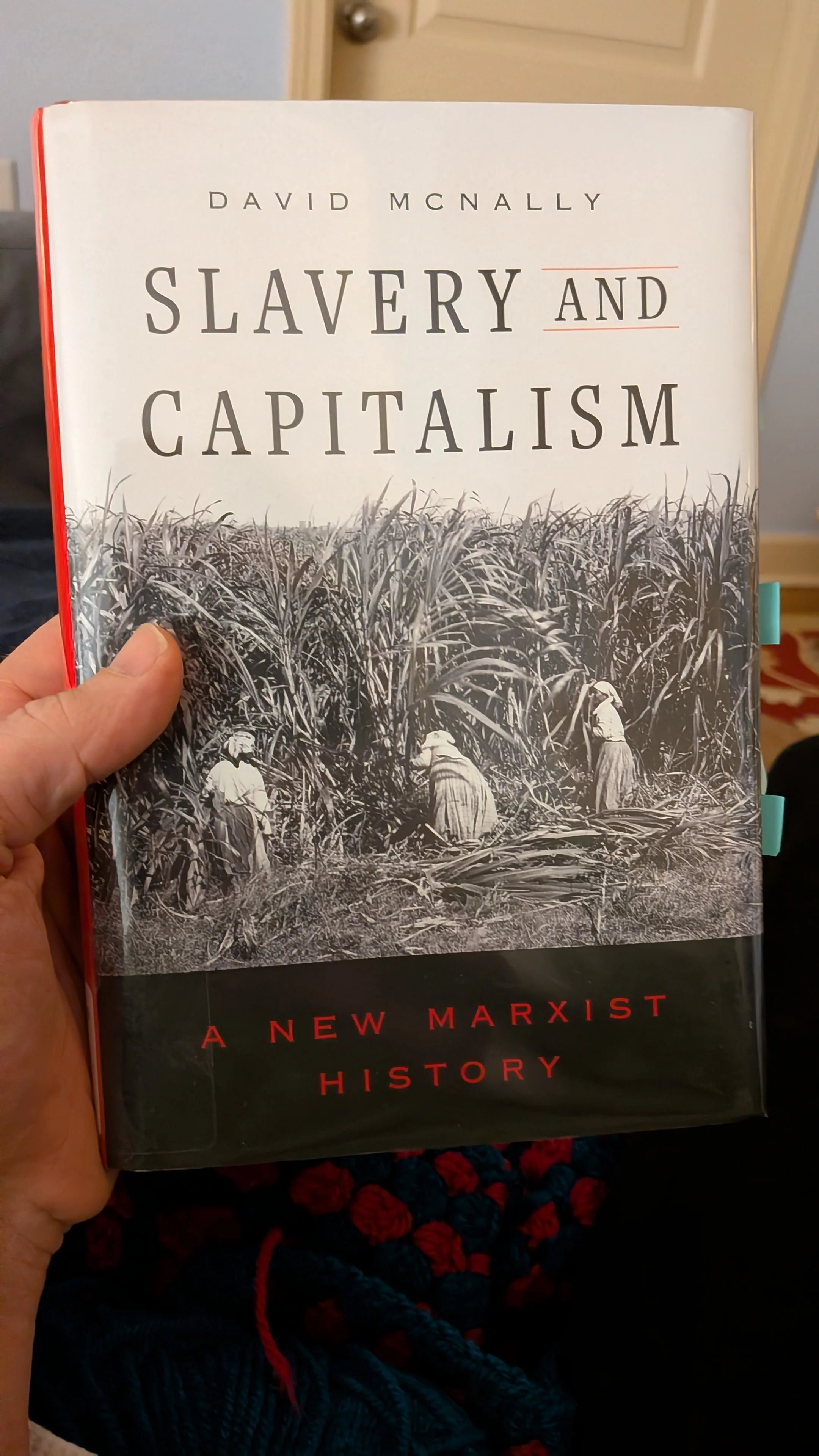
SLAVERY AND CAPITALISM: A NEW MARXIST HISTORY - DAVID MCNALLY
A fun take on the famous CAPITALISM AND SLAVERY book by Eric Williams, which I believe I reviewed last year. This book, thankfully, takes a different angle on the capitalism/slavery debate. Williams points out how the money made during slavery gets funneled into industrialization and capitalization in England and then the rest of the world. It shows us how Slavery was from an earlier mode of production, but the surplus made off of slavery allowed for capitalism as we know it to develop. McNally thinks that this dividing line is actually much more blurry, and that Atlantic Slavery was not a totally distinct, pre-capitalist mode of production, but was instead capitalistic in nature and should be thought of as part of the larger story of capitalism, instead of as the prelude. To me, the most convincing and relevant sections had to do with treating the slaves themselves as real people. Normally, the line of logic goes that since slaves are slaves, they are not proletarians who, definitionally are free labor who are in conflict with capital. McNally goes to great lengths to show that slaves were not “dead labor” or “fixed cost” that didn’t need to be negotiated with on an ongoing basis. He illuminates a long history of not only major slave rebellions in the Atlantic world, but also work slow-downs, the tactic of running away but coming back when a demand is met and other tactics of resistance that have equivalence in the “free” labor world. He shows how many slaves actually did make money, they could rent their skills (usually blacksmithing or carpentry) to others for money that they could use to better their lot or, ideally, buy their freedom. Many of the major leaders of slave rebellions, from Denmark Vesey to Gabriel Prossner, belonged to this class. Likewise, he takes on that old chestnut that slavery retards industrialization by showing that the slave South was one of the most industrialized areas in both the USA and the world at large at the time. While the north was more industrialized, the South was building railroads and using steam powered engines in major projects throughout this time, and, if it was considered its own country, the South would have been one of the most industrialized counties in the world at the time of the Civil war. He finally shows how involved Marx himself was in the anti-slavery struggle and how he saw these struggles as connected. The Eric Williams book of the same (tho, reversed) title is more thorough and puts forward a better case for why slavery formed the material basis for capitalism and how these modes fed into each other. This book does a good job correcting some of the common misconceptions about this relationship; the part about treating slaves as full people and political/economic actors was much needed and the best part of the book. It says, “a new Marxist history” on the cover but, besides long sections about Marx the person and his campaign against slavery (which was quite interesting) there isn’t too much marxist analysis. Overall, I don’t think I’d recommend this book to someone new to the idea, since it doesn’t go “big” enough, but I would recommend it to someone who has thought about these issues and wants to deepen their understanding.